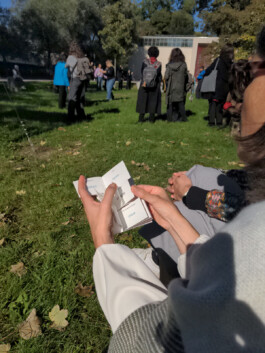
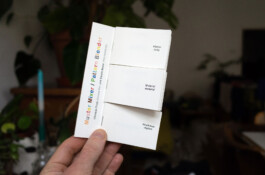
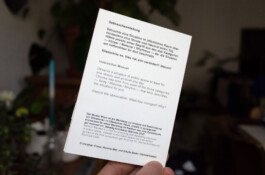
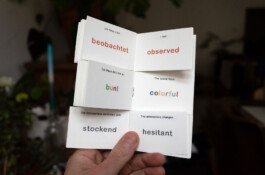
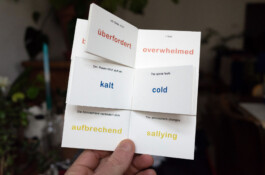
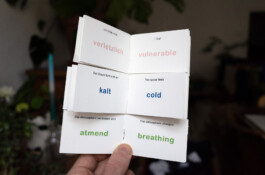
At the get involved VII symposium, organized by bink – Initiative for Built Environment Education for Young People and held at the Biennale Architettura 2025 in Venice in October 2025, the “Pattern Blender / Mustermixer” was presented and tested as an experimental tool for participatory analysis and creative engagement in public space in a hands-on workshop format.
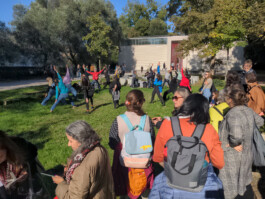
The workshop was structured around two groups with complementary roles: an observing (analyst) group and a playing (acting) group. The interaction between these two groups formed the core dynamic of the workshop.
The first group engaged with the Pattern Blender as a tool for observation and critical assessment. Participants were asked to carefully observe a situation in public space over several minutes or longer. Following this, they described the perceived qualities and effects of the situation using the three core categories: body, material, and rhythm. The categories enabled participants to develop subjective readings of space while also sharpening their awareness of subtle spatial dynamics. Importantly, participants were encouraged to reflect on their own position within the process.
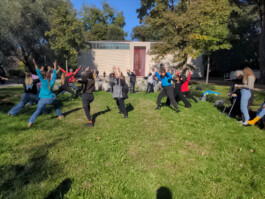
In contrast, the second group used the Pattern Blender as a performative and experimental tool. Rather than observing, they actively constructed situations in public space by “playing” through different scenarios. These scenarios were based on clichés of how certain groups act in public space, such as noisy groups gathering together or groups of people practicing yoga in a park.
Through deliberate and sometimes disruptive actions—referred to as “wandalizing”—participants introduced irritations into the environment. These staged interventions were designed to provoke new perceptions and unsettle existing patterns.
Their actions directly influenced the observing group, creating a feedback loop: interventions generated new situations, which in turn required renewed observation and interpretation. This process of action and reflection makes the Pattern Blender something like a framework for dialogue between perception and transformation.
The workshop atmosphere was characterized by curiosity, enjoyment, and openness. Participants consistently described the process as both engaging and stimulating. A key strength of the tool lies in the simplicity of its three categories—body, material, rhythm—which allowed for immediate access while still enabling nuanced insights.
The Pattern Blender proved effective across varying contexts and levels of experience, demonstrating its adaptability for diverse groups. Participant feedback suggested that the categories and terminology could be further refined and expanded.
Overall we think that the Pattern Blender has great potential as a method for combining participatory analysis with creative intervention in public space. Its structured yet open-ended approach makes it particularly interesting for educational settings, workshops, and collaborative urban practices.
Future iterations may incorporate refinements of the categories and terminologies while maintaining the tool’s core principle: enabling accessible, embodied, and playful engagement with spatial environments.
Authors:
Sibylle Bader, Wanderklasse – Verein für BauKulturVermittlung
Christian Frieß, Korona Mai – Verein zur Förderung einer interdisziplinären Auseinandersetzung mit der gebauten Umwelt
+++ Verein zur Förderung einer interdisziplinären Auseinandersetzung mit der gebauten Umwelt +++